
Category: Amphibians
This frogs are endemic to a very small area in Southwestern Australia. Though drably colored on their dorsal surfaces, the front of their underparts is bright orange. A unique adaptation is that they lay their eggs in a jelly mass in a shallow, terrestrial depression instead of in water – here they develop, without swimming or food, into the adult stage. Destruction and disturbance of their very restricted habitat is threatening the survival of this species and their relative, the white-bellied frog (Geocrinia alba).
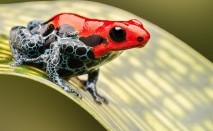
Swiss Army Skin
Amphibian skin is not covered in hair, feathers, or scales. It is thin and permeable, which allows them to actually breathe and drink through their skin! Their skin is not watertight, but they have mucous glands that produce secretions to help keep them from drying out Their skin also serves as a handy defense mechanism: nearly all amphibians have poison glands that make their skin toxic - and on top of that, it can even serve as a tasty treat after they shed it (yes, many amphibians eat their own sloughed off skin)!
Learn more >>
 Discover Animals is a web-based educational resource offered by the NAIA
